If you have seen “silicone leather” on a spec sheet and wondered whether it is just another name for fake leather, you are not alone. Silicone leather is a fabric base coated with silicone rubber — not a plastic imitation of leather. That single difference in the coating chemistry changes how it ages, how it feels, and where it can legally be used.
This guide answers the seven questions buyers actually ask, in the order they usually ask them: what it is, how it is made, how it compares, what it is good at, where it is used, what it costs, and where it falls short.
1. What Is Silicone Leather, Exactly?
Silicone leather is a three-layer composite:
- Base fabric — polyester knit, woven, or non-woven. This carries the strength and dimensional stability.
- Silicone coating — typically 0.12–0.20 mm of addition-cured silicone rubber. This carries the look, the hand feel, and most of the performance.
- Surface finish — a very thin top treatment (0.001–0.005 mm) that sets the grain, the gloss level, and stain resistance.
There is no polyurethane, no PVC, and no solvent-based binder anywhere in the structure. The coating is silicone all the way through, which is why it behaves so differently from PU leather under heat, sun, and moisture.
2. What Is Silicone Leather Made Of?
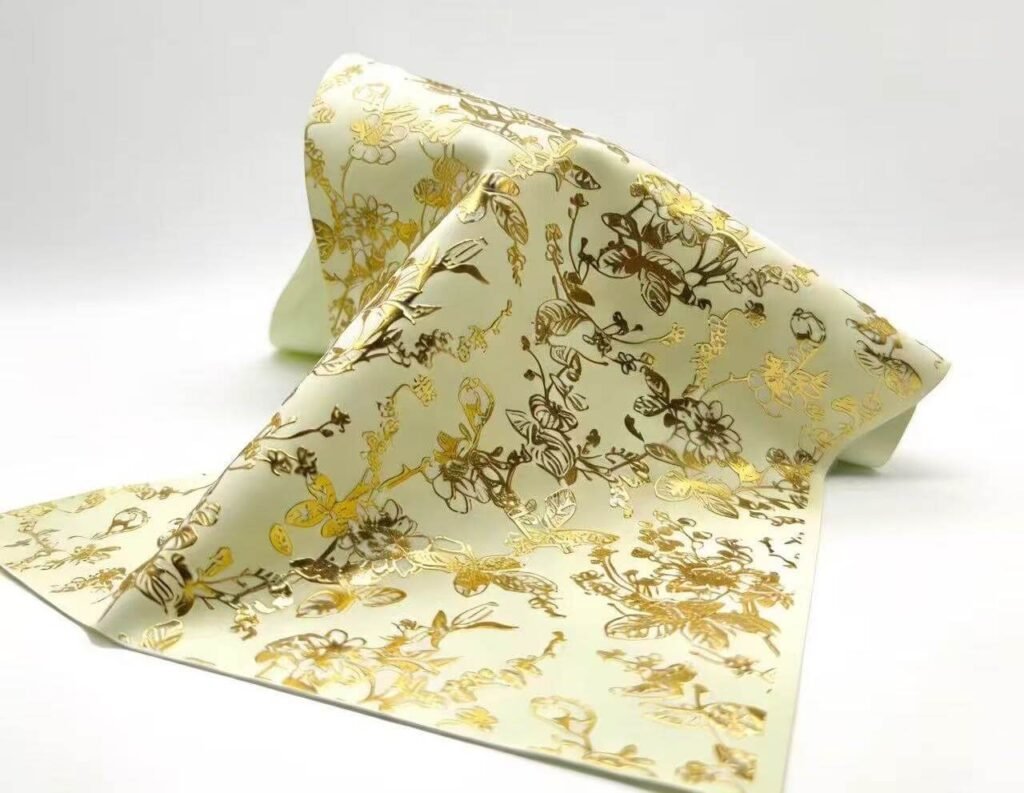
The performance of silicone leather comes from how precisely each layer is built, not from the silicone alone.
The base fabric decides how the material behaves under tension. A 100% polyester knit gives stretch and recovery for seating; a woven base gives dimensional stability for flat panels and wall covering; a non-woven base is used where weight matters more than strength. A cheap base will fail before the silicone coat does.
The silicone coating is where the cost sits. Addition-cured (platinum-cured) silicone is used for upholstery because it contains no solvent and cures without shrinking. Thickness typically runs 0.12–0.20 mm. Below 0.10 mm the coating wears through at high-abrasion points; above 0.25 mm the material becomes stiff and expensive without added benefit.
The surface finish is only a few microns thick, but it decides everything a buyer notices in the first five seconds: gloss level, hand feel, fingerprint visibility, and how easily stains wipe off. This is also the layer that carries the grain — litchi, nappa, suede, or a custom emboss.
The critical point: all three layers are bonded without adhesive. The silicone is cast directly onto the fabric and cured in place, so there is no glue line to delaminate later. That is the most common failure mode in laminated PU products, and it is structurally absent here.
3. How Silicone Leather Is Made
Four steps, and none of them involve coating the fabric with plastic:
| Step | What happens |
|---|---|
| 1. Coating | Silicone compound is knife-coated onto the base fabric |
| 2. Curing | Heat cures the silicone into a solid rubber layer |
| 3. Embossing | A release paper or embossing roller presses in the grain — litchi, nappa, or suede |
| 4. Finishing | Surface treatment sets gloss, anti-fingerprint and stain resistance |
Because the grain comes from release paper rather than a chemical process, the same base roll can be produced in smooth, litchi, nappa, or a custom texture you specify. This is also why small-batch custom grain runs are practical.
4. What Makes It Different from PU and PVC
The top layer is the whole story:
| Silicone leather | PU leather | PVC leather | |
|---|---|---|---|
| Top layer | Silicone rubber | Polyurethane | PVC |
| Hydrolysis resistance | 10–20 years | Roughly 3–5 years | Roughly 5–8 years |
| Outdoor UV life | 5+ years | Yellows in 1–2 years | Cracks and fades |
| Temperature range | -40°C to 200°C | About -10°C to 70°C | About -10°C to 60°C |
| Feel at low temperature | Stays soft | Hardens | Hardens |
| Phthalates | None | Possible | Yes |
| Main weakness | Material cost | Humidity, sunlight | Cold, aging |
Figures for PU and PVC are typical industry ranges, not guarantees — always ask for the specific supplier’s test data.
5. Common Misconceptions About Silicone Leather
“It is just a marketing name for PU.” No. The coating chemistry is completely different. PU is polyurethane; silicone leather uses silicone rubber. They fail for different reasons — PU under hydrolysis and UV, silicone almost never under either.
“Silicone leather is plastic.” Silicone is an inorganic polymer with a silicon-oxygen backbone. It contains no phthalates, no plasticizers, and no PVC. That is why it can pass PFAS-free and food-contact requirements that most coated fabrics cannot.
“It will feel cold and rubbery.” This depends entirely on the grain and finish. A nappa emboss with a soft-touch top coat reads as leather in the hand. A high-gloss smooth finish reads as rubber. Same material, opposite impression — which is why the finish spec matters as much as the coating spec.
“It is only for outdoor or industrial use.” Automotive interiors, hotel lobbies, yacht saloons and medical waiting rooms are all normal applications. The material is chosen for cleaning labor and replacement cycles, not for extreme conditions alone.
6. Key Properties at a Glance
| Property | Typical value |
|---|---|
| Abrasion (Martindale) | 5,000–20,000 cycles |
| Temperature range | -40°C to 200°C |
| UV resistance | 5+ years outdoor |
| Hydrolysis resistance | 10–20 years |
| Flame rating | B1–A1 per EN 13501 |
| Alcohol resistance | Repeated wiping, no damage |
| Stain resistance | Yes — soap and water cleanup |
| Mold and mildew | Resistant |
| Weak acid and alkali | Resists daily exposure |
| Hardness | Customizable to the application |
| PFAS | Free by formulation |
On the PFAS point specifically: silicone leather contains no fluorinated compounds at any layer. For background on why PFAS restrictions keep expanding in furniture and textile supply chains, see the US EPA PFAS overview.
7. Where Silicone Leather Is Used
Automotive interiors — dashboards, door panels, seat bolsters. Handles summer heat and UV without cracking or turning glossy.
Marine upholstery — salt fog, direct sun, and constant moisture. This is the environment where PU usually fails first.
Medical and healthcare — repeated disinfection with alcohol and hospital-grade cleaners, which destroys most coated fabrics within a year.
Furniture and hospitality — hotel seating, restaurant booths, and high-traffic public areas where cleaning happens daily.
Outdoor gear and consumer products — tent fabric, motorcycle saddle covers, and molded phone cases.
8. How Much Does Silicone Leather Cost?
Buyers usually ask for a price per meter before they understand what drives it. As a rule of thumb, silicone leather is priced two to four times above PU at material level, and the cost breaks down roughly like this:
- Silicone compound — the largest share, and the reason the gap exists
- Base fabric — varies widely by knit versus woven
- Emboss paper and finishing — custom grains cost more than stock grains
- Order quantity — coating lines run efficiently above a few hundred meters
The honest calculation is not cost per meter but cost per service year. A PU surface in a humid or sun-exposed installation often needs replacing within three to five years. Silicone leather in the same position typically runs ten to twenty. Divide the material cost by the years in service and the ranking usually reverses.
Ask your supplier for three numbers before comparing quotes: coating thickness in millimeters, Martindale cycles on the actual production lot, and hydrolysis test conditions. A quote without these is not comparable to another quote.
9. Where It Does Not Make Sense
Honest answer: budget-driven, short-life products. If you are producing a promotional item with a twelve-month life and cost is the only driver, PU will do the job for less.
It is also the wrong choice if you specifically want the natural aging character of real leather — the patina, the way it softens and darkens with use. Silicone leather looks essentially the same twelve years later. Some buyers consider that a feature; others find it too uniform.
10. Silicone Leather vs Faux Leather: What’s the Difference?
“Faux leather” is a catch-all term covering PU, PVC, and microfibre leather. Silicone leather is technically a faux leather too, but it is the only one in that group that is silicone-based rather than plastic-based.
This matters because regulations increasingly treat them differently. Phthalate restrictions, PFAS reporting, and some furniture flammability standards apply to PU and PVC. A silicone-coated material usually falls outside those specific requirements — but confirm with actual test reports for your lot, not with the category name. The EU framework behind these obligations is summarized in ECHA’s REACH overview.
When a spec sheet says “faux leather”, ask one question: what is the coating chemistry? Polyurethane, PVC, or silicone. The answer determines the lifespan, the compliance path, and the price.
11. How to Tell Real Silicone Leather from PU
Three quick checks before you approve a bulk order: the flame test result against EN 13501, how the surface behaves after a minute in a hot car, and whether the spec sheet states PFAS status and coating thickness. We cover the full method in our guide on spotting PU imitations, and if you are still comparing substrates, start with the full PU vs PVC comparison.
12. FAQ
Is silicone leather real leather? No. It is a fabric base with a silicone coating and contains no animal hide. The name refers to the hand feel, not the origin.
Is silicone leather breathable? Less breathable than uncoated fabric, comparable to other coated upholstery. That is why seating designs use perforation, quilting, or channel stitching to manage heat and moisture.
Does it actually feel like leather? Yes, if the grain is embossed well. Nappa finishes come closest to soft automotive leather; suede finishes feel warmer and more textile-like.
Is it more expensive than PU? At material level, typically two to four times the cost of PU. Across a replacement cycle the gap narrows considerably, because PU in humid or sun-exposed conditions often needs replacing within a few years. To see how abrasion figures are actually measured, read how abrasion tests actually work.
Can silicone leather be recycled? The silicone layer can be reground in some industrial streams, but fabric-silicone composites are generally not kerbside recyclable. Ask your supplier for their end-of-life guidance before you specify it for a sustainability claim.
Can it be used outdoors year-round? Yes, within the UV rating of the specific product. A five-year outdoor rating is typical, not universal — request the weathering test report rather than assuming.
13. Request Samples
Want to compare this against the material you are using today? Tell us the application and the grain you are considering, and we will send swatches so you can test it yourself. See our silicone leather range or request samples directly.