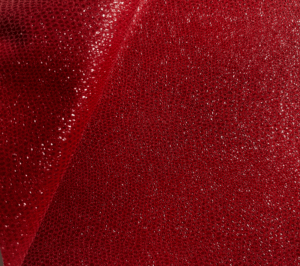
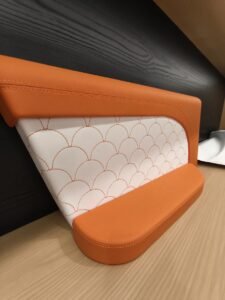
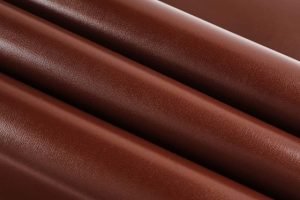
Silicone leather for walls closed a gap that paint and fabric both left open. Paint gives you a flat plane. Fabric gives you a soft one. Neither gives you a surface a family can wipe. Silicone leather looks and behaves like leather, but it is an elastomer coating bonded to a textile backing — no plasticiser, and no PVC top layer that goes brittle after a few summers.
That difference matters more in a home than in a car or a boat. A hotel lobby is cleaned on a schedule. A family home is cleaned by whoever notices the crayon first.
Why silicone leather for walls is replacing vinyl in home interiors
Most of what the market sells as “silicone leather wall covering” is PVC or PU with a printed grain. It looks convincing in a swatch book and then behaves badly six months in: the plasticiser migrates, the surface hardens, and the creases you get at a corner become permanent. If you want the full technical breakdown of how silicone differs from what comes through the material from the backing, our guide to what silicone leather actually is covers the three-layer construction in detail.
Three properties do the work in a residential setting. The surface is a silicone elastomer, which has a low surface energy — spills sit on top instead of soaking in. It contains no plasticiser, so it does not shrink, harden or crack with age. And it stays supple across a wide temperature range, which is why the same material works on a cold north-facing hallway and a sun-exposed south wall.
If you are weighing it against older coated fabrics, the honest side-by-side is in silicone leather vs PU vs PVC — including the cases where PU is still the cheaper correct answer.
The two ways it gets used in a home
Full wall coverage. Panels or rolls bonded to a prepared substrate, usually with seams planned on a drawing rather than discovered on site. This is the finish that replaces paint in feature walls, hallway runs and stairwells, and it is specified on a microfibre or suede-touch backing because that base is what carries the abrasion load. Silicone leather rolls for this use are bought by width rather than by the metre.
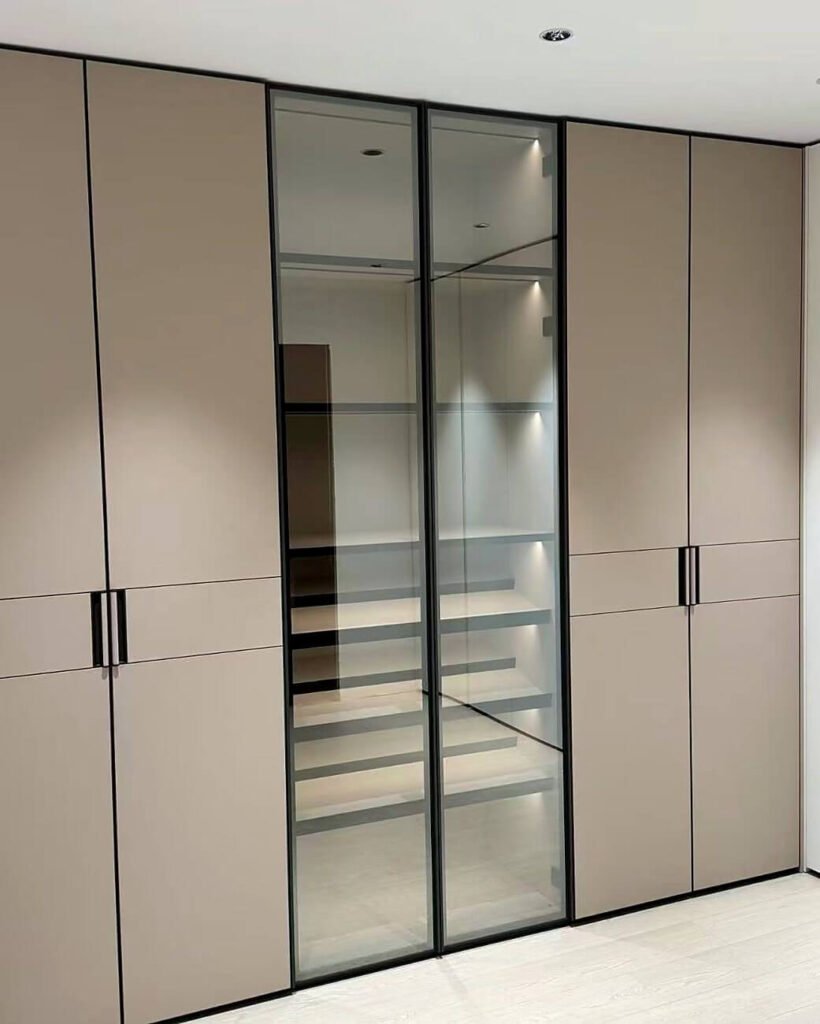
Cabinet wrapping. Wardrobe doors, kitchen cabinet fronts, bedside units and headboard surrounds. Here the construction is normally PET-backed: a rigid, dimensionally stable panel that wraps a clean edge, does not telegraph imperfections in the substrate, and stays flat across a wide front. The trade-off is abrasion resistance, and it is the reason the two uses carry two different test numbers — explained in the section below.
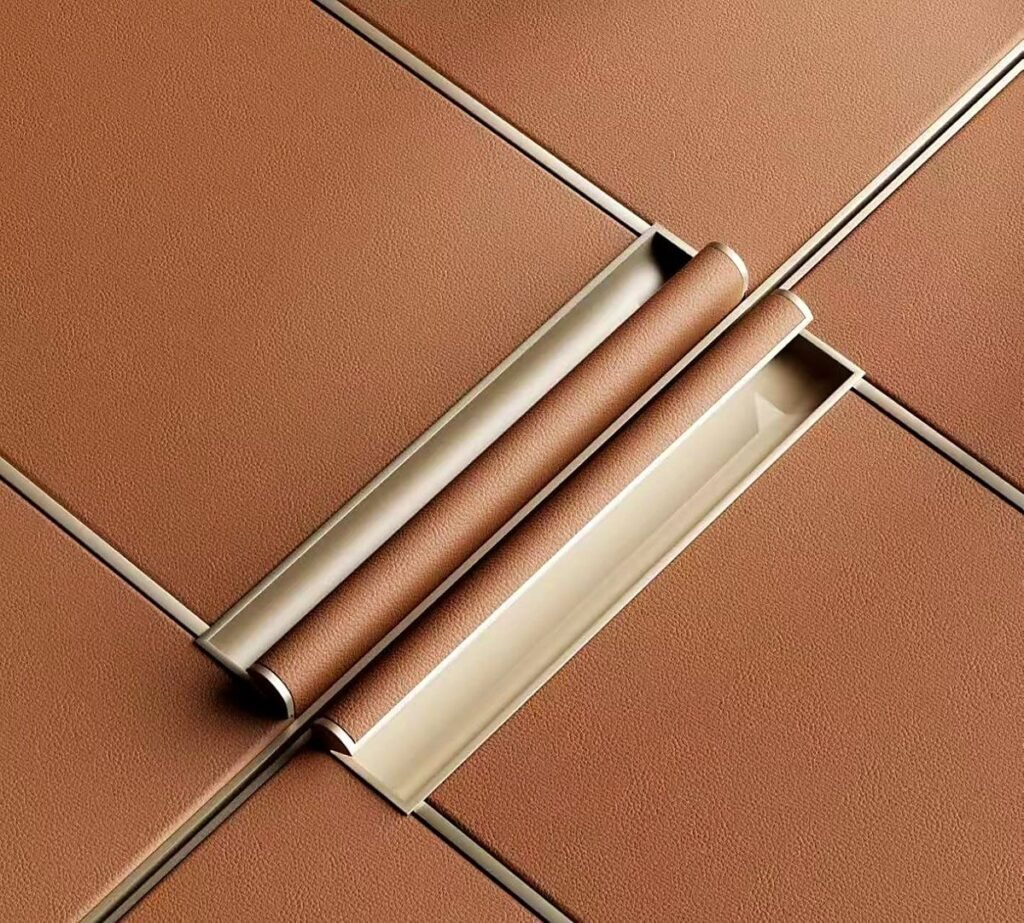
What changes when you wrap a wall instead of a sofa
A sofa can hide a seam under a cushion. A wall cannot. Before you order, three things need to be settled: the roll width against your wall height (our standard is 1,370 mm, which covers most full-height panels without a horizontal join), the seam layout, and how the edges are terminated at skirting and ceiling. Get those three right and the finish reads as one continuous surface.
The five tests a home spec has to survive
Every claim below should be backed by a test report you can read, not a line on a spec sheet. This is the list we would ask any supplier for.
1. Scratch resistance: fingernails, keys, toy corners
The surface is an elastomer, so a fingernail presses in and springs back rather than cutting a groove. That is the difference between scratch-resistant and scratch-proof — nothing in this category survives a Stanley blade, but daily abrasion from keys, zips, vacuum heads and children’s toys is a different order of load. Ask for a scratch test on the actual grain you are buying, because a smooth top and a deep emboss do not behave the same way.

2. Abrasion: the backing decides the number, not the coating
Martindale results on silicone leather are governed by the backing more than by the silicone itself — the ISO 12947 series defines how the cycles are counted. Three constructions give three very different answers, and this is the single most common place where a quote comparison goes wrong.
Microfibre or suede-touch backing — 20,000 Martindale cycles. This is the wall grade. The soft base absorbs rubbing instead of transferring it to the coating, which is why a full wall panel can hold its surface for a decade under occasional contact.
PET backing — 2,000 Martindale cycles. PET gives you a rigid, dimensionally stable panel that wraps a crisp edge and stays flat across a cabinet front. The hardness that makes it good at that job is also what limits abrasion life: the base does not absorb the rubbing action the way a microfibre base does.
So the honest answer to “how many cycles does it take?” is another question: which backing, and where is it going? A supplier quoting a single number for the whole range is quoting the best case. If your project combines walls and cabinet doors, specify both constructions — the difference is a line on the quote, not a failure in year three. The method itself is worth understanding before you compare two quotes, and we broke that down in Martindale vs Wyzenbeek.
3. Stain resistance: oil, crayon, and the permanent marker exception
Cooking oil, coffee, felt-tip and wax crayon all wipe off a damp cloth with a neutral detergent, because the coating does not absorb them. Two honest exceptions: solvent-based permanent marker can leave a shadow and needs isopropyl alcohol, and turmeric-based sauces need to be caught the same day rather than the same week. The full routine, including what not to use, is in our cleaning and maintenance guide.
4. Service life: ten years is a claim, hydrolysis is the mechanism
A ten-year service life in a residential interior is realistic for silicone because the failure mode that kills PU — hydrolysis, where moisture attacks the polymer chain — is what silicone is most resistant to. We publish hydrolytic stability figures up to 10–20 years on the grades where that data exists, and the technical data sheet lists them per construction rather than as one blanket number.
5. Fire performance: B1 to A1 under EN 13501-1
Wall coverings are regulated differently from loose furniture, and this is the point where a cheap import usually fails. Our constructions classify from B1 through to A1 under EN 13501-1, with test reports available per construction. ASTM E84 surface-burning data is available for projects specifying to US codes instead. If your project has a fire consultant, send them the report before the sample — it is the document that decides whether the finish is allowed, not the colour card.
How to specify it without getting burned
Six things worth doing before the purchase order, in order:
Name the backing on the drawing. “Silicone leather” on its own does not specify a product. Microfibre for the wall, PET for the door — write it down, because the abrasion figure follows the base and nothing else.
Read the test report, not the brochure. Ask for the report number, the construction it was tested on and the date. A number without a construction attached is marketing.
Sample in your own light. Colour shifts between a supplier’s studio and a north-facing hallway. Request samples in the colours you are actually considering and look at them on site.
Confirm the PFAS position in writing. “Eco-friendly” is not a specification. If stain resistance is the reason you are buying, you need to know it was not achieved with a fluorinated treatment — what PFAS-free means for upholstery explains why this question keeps coming up in tenders.
Get a seam drawing. Roll width, panel layout and termination details, drawn before production. This is the single most common cause of a job looking wrong on site.
Agree the maintenance routine with whoever cleans the building. A finish that only the specifier knows how to clean gets cleaned with the wrong product within a month.
Questions we get asked at the sampling stage
Can it go in a bathroom? In dry zones and on vanity surrounds, yes. Direct, repeated water exposure needs a specified waterproof backing and sealed edges — treat it as a wet-area system, not as a standard wall panel.
Does it peel off the wall? Only when the substrate was not prepared or the wrong adhesive was used. Bond strength is a function of the wall, the primer and the adhesive, which is why installation instructions belong in the quote.
Is it more expensive than paint? Per square metre, yes. Per year in a hallway that would otherwise be repainted twice, it is usually the cheaper line — and it is the only one of the two that a buyer can touch.
What this means in practice
If your project is a feature wall, a hallway run or a set of cabinet fronts that has to survive a family, silicone leather for walls is the finish that keeps its surface after the novelty wears off. The specification decisions that matter are narrow: backing, grain, colour, roll width and fire class — everything else is installation discipline.
Send us the wall drawing, the panel sizes and the fire requirement, and we will come back with the constructions that fit and the test reports behind them. Request a quote, or start with a physical swatch.